Saga’s Journey Home, Day 1 (January 20, 2014)

This is a post of Saga’s Journey home, Day 1.  I have included Facebook posts, in blue, from myself, friends and family. I have agonized over this — trying to get it to look just like it did in my Word doc, but I guess I can’t blog the way I can Word :).

Stay tuned for more posts about the trip from Georgetown, SC to Beaufort, NC, where Saga eagerly awaits future adventures under a new captain. Maybe I can shame He-Who-Should-Not-Be-Named into sending me his posts from days 3 forward :)!

Respectfully submitted,

Kelly


January 20

Today Kevin and I began Saga’s journey from the Harbor Walk Marina in the Sampit River in Georgetown, SC to Dudley’s Marina in Swansboro, NC.  In Swansboro we will finish removing all of Keith’s belongings and leave Saga stripped of everything that is not “her own”.  From there, we plan to put her in dry storage for at least a few months while we decide what to do with her.

We are *almost* as connected to this little boat as we were to Keith.  I guess since Keith is gone, we feel an even stronger connection to Saga, and an overwhelming need to keep her safe.  To that end, we begin a 190 mile journey that will span four..five… who knows… days long.
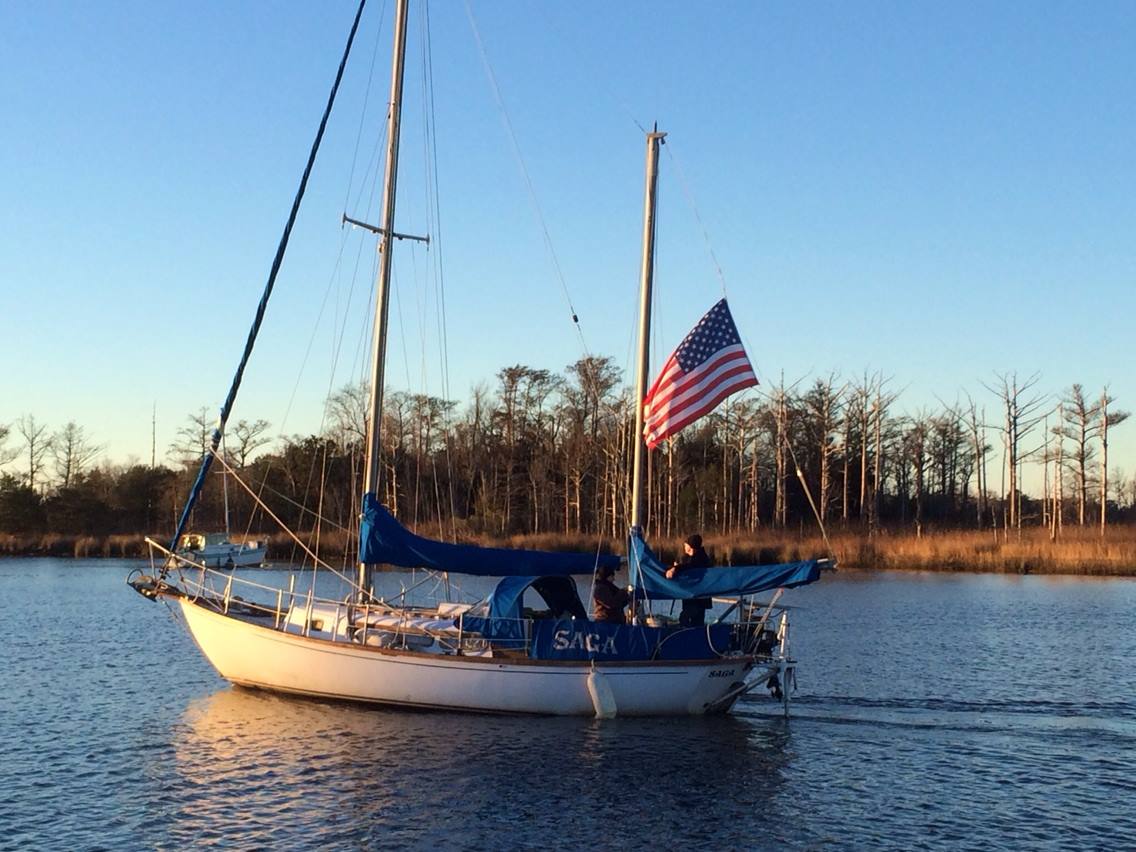

Setting Sail

January 20 Wesley Wyatt
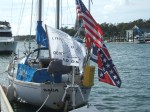
Kelly & Kevin setting sail
 
January 20 Stephanie Holt Sullivan
Kevin Sullivan and Kelly Wyatt heading north on Saga. Such an appropriate name. Safe travels guys, stay warm.
 
January 20 Kim Sullivan Oestereich
They are sailing siblings … Kevin P. Sullivan and Kelly Sullivan Wyatt … I want to hear the story after this adventure! ENJOY it as much as possible!! Keith loved you and loved Saga… And would want you guys to enjoy the journey… Hugs!!!


We left Kenny and Wes behind in Georgetown to handle paperwork and stay in contact with the authorities who continue to search for Keith.  This would be a great adventure with Kevin under different circumstances, and I am very sad that I never took the time to go sail with Keith.
 
It would have been nice to leave Georgetown on a day and at a time when we could motor Saga along the Harbor Walk so that all of Keith’s boating friends and family could pay respects to a sad little boat who is leaving her captain behind, but, we had “fair weather and following seas”, a VERY long way to go, an unfavorable forecast for the days to come, and little knowledge about Saga, her idiosyncrasies and the waters ahead, so we left as early as possible.
 
The first order of business was for Kevin to give me a crash course in sailing.  Remember that Kenny is a motor-boater, Kevin is a sail-boater, and I am a “no-boater”.  Kevin and I had our own adventures together sailing a little sunfish on the Hudson when we were teenagers, including one time the current took us so far upstream we could not get back without the help of a Big Sailboat that towed us home… but I didn’t have “formal” sailing training like Kevin and Keith had.  Yes, I know that to turn  a boat you move the tiller in the opposite direction, but that’s about it.
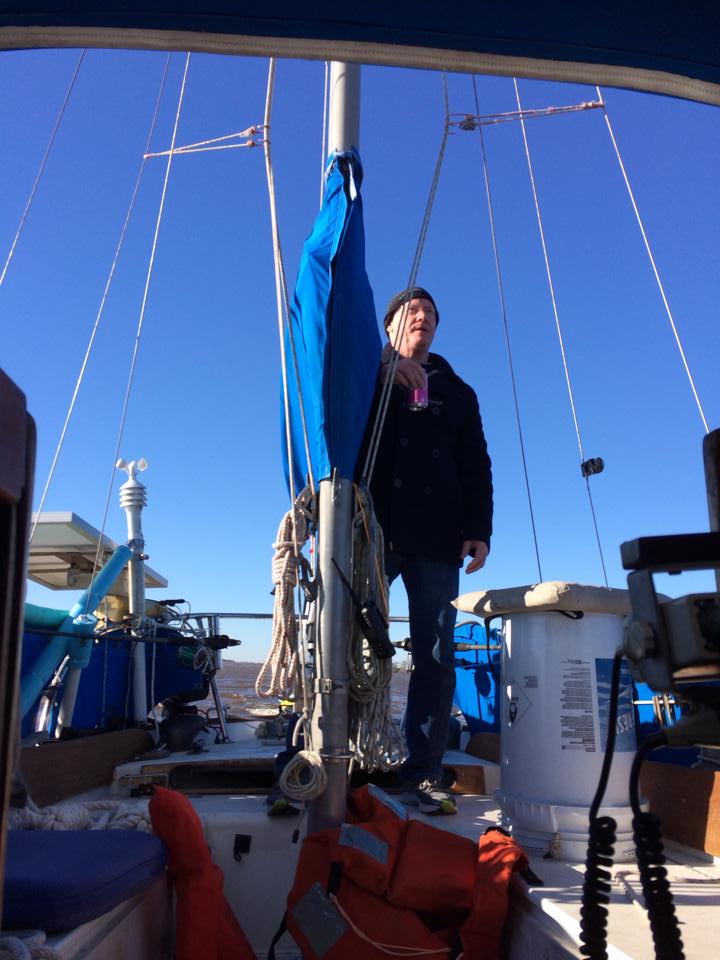
 

Captain Kevin

Captain Kevin


So, Kevin proceeds to explain to me the engine controls: One for speed, one to put it in gear.  At least I think that’s what I remember.  He ends this little lecture with something like “If I fall overboard, just kick it out of gear and turn the tiller and come back to get me. ”  (HELLO?  IF YOU FALL OFF????)  “But, I’m NOT going to fall off.”  Phew, thanks for THAT, Kevin.  And you think in a panic, after what we have been dealing with during the past few days, I am going to remember what you told me?  I don’t even know if I’ve recorded it correctly!
 
Next we go through other important things.  Like the LEFT side of the boat is the PORT side (“See, they are both 4 letters.”), the RIGHT side is the STARBOARD  side.  The BOW is… well, the front of the boat, and the STERN is the back.  OK.  Maybe he told me little memory tricks for bow and stern, but frankly, my head was getting full, my ears were cold.
 
Kevin turned the helm over to me (is that the correct nautical term?) once he knew that I could *at least* steer Saga and busied himself with getting other things situated on the boat.
You can't tell that I am steering Saga with my foot. So far, Kevin P. Sullivan would rate my sailing as adequate, I think.

You can’t tell that I am steering Saga with my foot. So far, Kevin P. Sullivan would rate my sailing as adequate, I think.


We made it from the Sampit River into the Intracoastal Waterway and proceeded north, cruising along at a whopping 4.5 MPH.  Did I mention earlier that we have 190 miles to go, and, approximately 10 hours of daylight each day?  Doing the math, that is about 45 miles a day, and that is about 4 1/2 long days of sailing.  Did I mention the unfavorable forecast?  Kevin and I expected two reasonably warm days, but, Wednesday was supposed to be very cold and very windy, and then Thursday and Friday was expected to be even colder.   We really wanted to get as far as we could today.
 
That’s about the time that Kevin decided he wanted to put the “sail” into my sail boating education.  So I learned that the “jib” sail is the most forward sail on the boat, the “mizzen” sail is the sail that is furthest back and that the “main” sails are in between.  And, oh, one is a furling sail, which looks to be a pretty cool thing.  And…. we are going to use one of them.
 
So Kevin tells me about how there are two lines on the jib sail (one port and one starboard), and I’m thinking there might be another one, too, used for furling and unfurling the sail.  So, we let out the sail secure it to one side and Voila!  Another MPH or so.
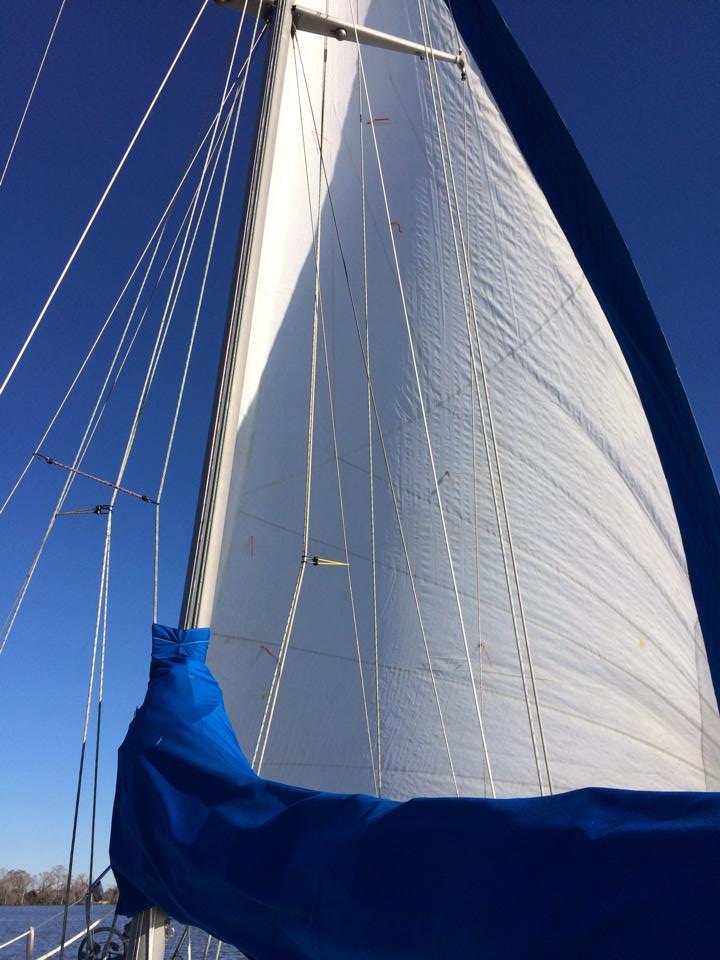
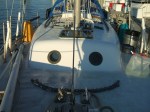
Saga's Jib Sail

Saga’s Jib Sail


Saga looks so pretty “under sail”… even if it is just one sail.  That is, until the wind shifts and we need said sail on the other side of the boat.  Now Kevin wants me to learn about “jibing the jib”.  Do what?
 
Loosen this rope, tighten that one, secure … was it this or that rope?…, pull a rope.  How hard can it be? I soon learn that moving the sail between sides of the boat is not that hard, and, can happen single handedly.  I guess that is a large part of why it was possible for Keith to sail Saga alone.    I proudly announced to Kevin that I posted to Facebook that I can now “jibe a jib”, and he dashes my confidence by asking me how I spelled “jibe”.  Well, J-I-B-E, of course, how else you spell it?  WRONG he tells me!  It is G-Y-B-E.  Now why would it be like that???  Not to be put down, I pull out my smart phone and soon report to Kevin that both spellings are acceptable.  So, I am very happy to be able to jibe the jib, and if he wants to gybe the jib, that is fine with me!  Looking this up while writing this article I found this very useful glossary of nautical terms.

January 20 Kelly Sullivan Wyatt
I now know how to jibe a jib.


Now  we are cruising along.  We are traveling along beautiful areas of the ICW.  We see herons and other water fowl, we travel through cypress swamps.  The canal is very calm, and we have an opportunity to talk and reminisce about Keith, his sailing, how much he loved Saga and what a cool little sailboat she is.  We have lots of opportunities to take pictures of the canal, we have cellular access, so we can share these pictures with our friends and family who are anxiously waiting to hear how our journey is progressing.
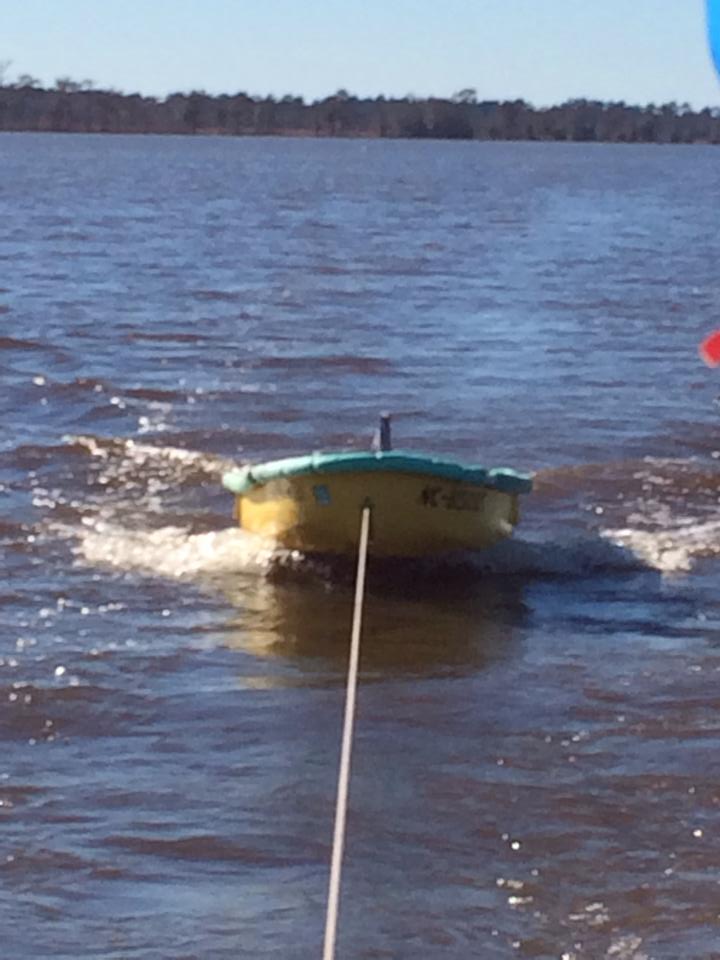
 

Our ever-faithful follower

Our ever-faithful follower


Beautful day and a beautiful area to cruise

Beautiful day and a beautiful area to cruise
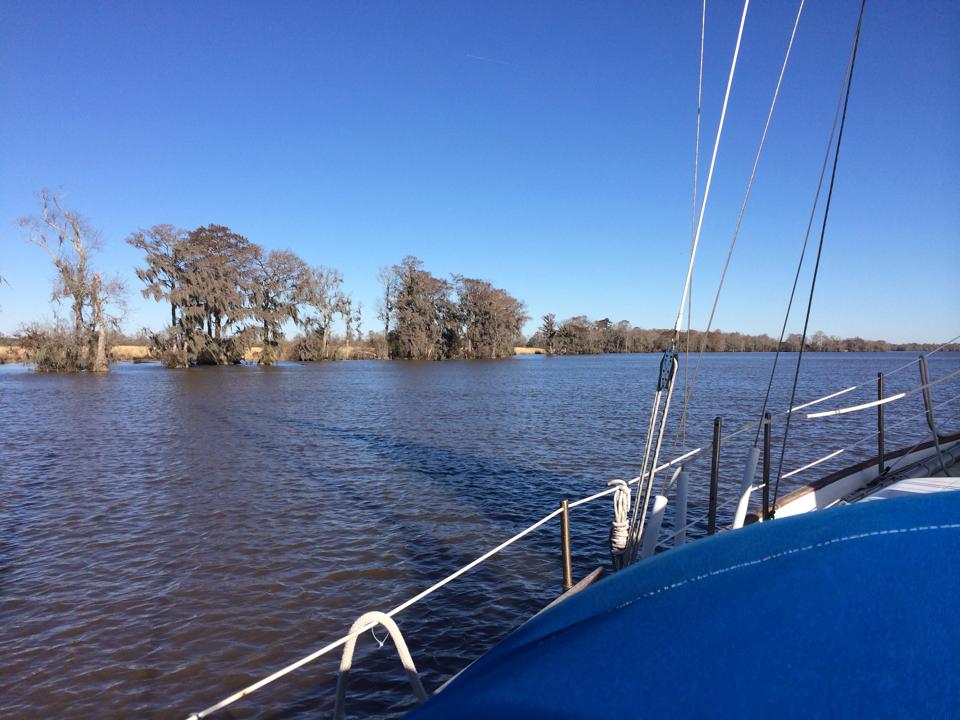
 

More pretty views
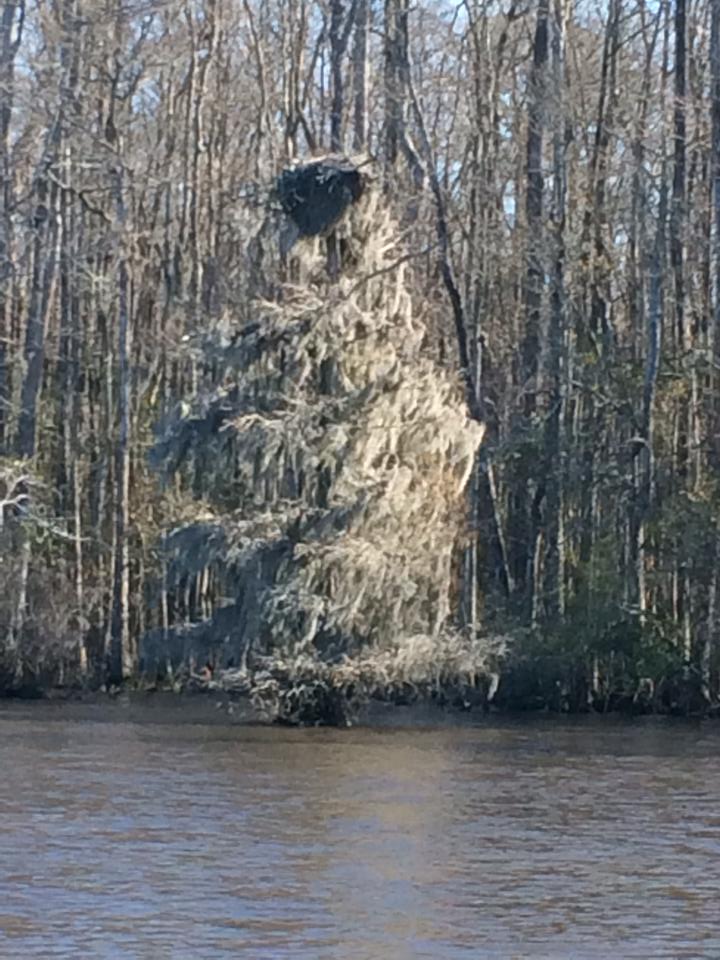
More pretty views


Spanish Moss covered tree

Spanish Moss covered tree


Along the way we came upon a group of people jumping up and down on a dock on the port side of the boat. We waved and went on by, but were soon hailed by none other than Keith’s good friends Thomas, Ellen and Alyson from the S/V Island Girl. It is too bad we didn’t know we would go right by there, or we would have stopped for a brief visit. And it is too bad we didn’t think to ask them to get a photo of Saga sailing by. It seems that is just another “woulda-coulda-shoulda” that we thought about during this entire time in our family.
 
Being the no-boater that I am, I have never had the experience of a swing bridge.  There are a number of these along the ICW, and we went through several along the way.  Here is a video I took.

January 20 Kelly Sullivan Wyatt
Swing bridge at approx 35 of 190 miles.

“The woods are lovely, dark, and deep,
But I have promises to keep,
And miles to go before I sleep,
And miles to go before I sleep.”

From Stopping by Woods on a Snowy Evening by Robert Frost. I will say I am glad the woods are NOT snowy… You, Kevin P. Sullivan??


The rest of our journey was uneventful.  There were more interesting things to see including:

a train bridge that stays up until a train comes
a train bridge that stays up until a train comes


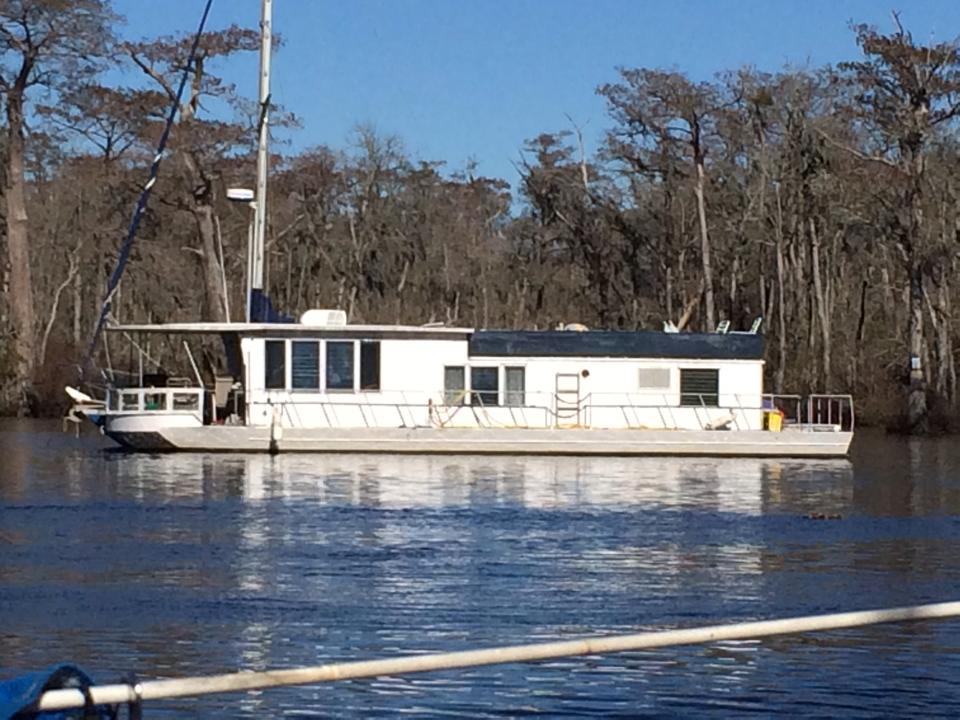
a pretty cool house boat

a pretty cool house boat


an osprey nest on the top of an old tree stump
an osprey nest on the top of an old tree stump


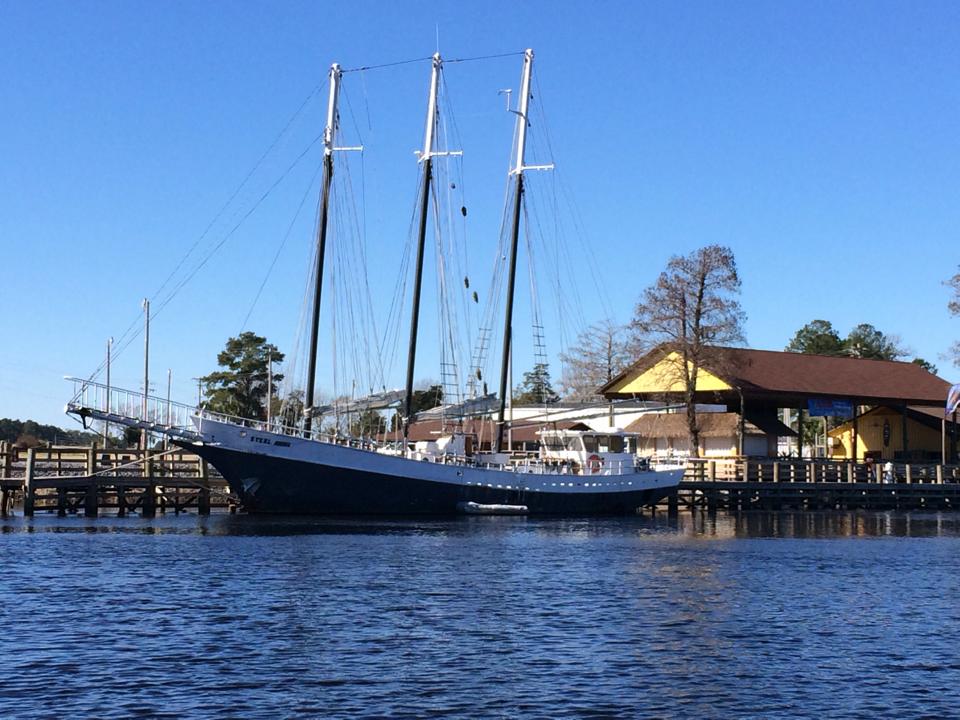
a pretty incredible three-masted sail boat

a pretty incredible three-masted sail boat


January 20 Kelly Sullivan Wyatt
near North Myrtle Beach, SC

We spent the last hour or better under sail only (no motor). Between the tide and the wind we went almost as fast as under motor earlier. Our max speed under motor+wind+current was approx 7.2MPH. We got to 6.3MPH with wind+current. It was quite peaceful and quiet when under sail only.


All in all, it was a long, but satisfying day.  We made it further than we expected.  We learned our way around Saga, and she tolerated us and took us unfailingly for 50 miles.  After docking at the Barefoot Landing Marina, where a wonderful dock master took us to the grocery store, waited while we shopped and gave us a recommendation for a good place to eat (get the ribs at the seafood restaurant!), we called it a night early and immediately fell asleep.

January 20 Kelly Sullivan Wyatt
near North Myrtle Beach, SC

Kevin and I made it from Georgetown, SC to N. Myrtle Beach, approx 50 miles today. Tomorrow we will end the day around Southport so that Kenny and Kevin can spend the next sailing day (probably Thursday, since Wednesday there is supposed to be really bad weather) going from Southport hopefully to at least Wrightsville. This is a tough leg since it is in more open water with more traffic… And bigger boats.


I shoulda, coulda taken a similar trip with Keith, and wish that I had made the time to do so.

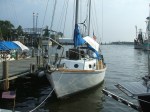
Barefoot Landing Marina, North Myrtle Beach, SC

Barefoot Landing Marina, North Myrtle Beach, SC

By Sullivan Family

A Captain is Lost

Dear followers, it is with heavy hearts that Keith’s brothers and sisters share Keith’s obituary.  We will be updating this blog with more of Keith’s sailing adventures, as transcribed from the many letters he sent to us over the years.  A few of us will attempt to match Keith’s writing prowess with our own as we record the home-bound journey of the S/V Saga from Georgetown, SC, where her captain was lost, to Bock Marina in Beaufort, NC where she rests while Keith’s family plots her next course.

— Kelly Wyatt

Keith Edward Sullivan

June 4, 1968-January 12, 2014

KeithKeith Edward Sullivan, 45, of Emerald Isle, NC, died January 12, 2014 by accidental drowning in the very waters he loved sailing. Keith was born June 4, 1968 in Houston, Texas to Janet (Jan) Lynch Sullivan and John (Jack) Francis Sullivan, who predeceased him.

Keith attended Cary High School and continued his education at Wayne Community College where he received an Associate’s Degree in Airplane Mechanics. But the pull of adventure was too strong and Keith went on to travel the country working odd jobs for many years before heading back to North Carolina. He then purchased his first sailboat, Soulshine, and traveled the Atlantic coast. Keith lived aboard his sailboats for many years, most recently S/V Saga, before his death. His sailing blog may be viewed at http://www.carolinakeith.com.

Keith is survived by a daughter, April Sullivan of Marathon, Florida; brothers Kevin and wife Stephanie of Hong Kong, Kerry and wife Hana of Sydney, Australia, Kenneth and partner Amy of Emerald Isle; sisters, Kelly Sullivan Wyatt and husband Wesley of Apex, and Kimberly Sullivan Oestereich and husband Bill of Apex. He will also be remembered by many nieces and nephews.

A memorial service will be held at St. Andrew the Apostle Roman Catholic Church, 3008 Old Raleigh Rd, Apex, NC 27502 at 11:00 Thursday, March 13. The family will receive visitors at 10:30 at the church.

In lieu of flowers, contributions can be made to the family for a service project that is being planned in memory of Keith. The family will purchase survival whistles to hand out to boaters to encourage safer boating. Donations may be sent to Kelly Wyatt, P.O. Box 4481, Emerald Isle NC, 28594.

The family would like to express their appreciation to the good people of Georgetown, SC, the Georgetown County Sheriff’s Office, the South Carolina Department of Natural Resources and the local boating community for their support and assistance during the days Keith was missing.

By Sullivan Family

Photo Gallery

Hunger

                                                              Oysters and Jam

This tale comes  from a time early on in my cruising days…

I had just gotten a job, but I was broke and hungry waiting for my first paycheck. I was on my annual migration south. Actually, I think it was my first annual trip southbound on the ICW. I had worked construction in the summer, so I had a little cash saved and I had some groceries stocked up. But being my first trip down the waterway I had a tendency to go ashore too often, and that was making my cash reserves go faster than I had planned.

When I sailed south from Charleston I knew that I would have to be stopping for a job soon. Being new to the areas I was traveling through, I did not know what to expect in the towns that lay ahead of me. One thing that I did know is that gasoline is expensive on the waterway, and my little motor was not fuel efficient. For that reason I sailed as much as possible, even in light or contrary winds. The only problem with that philosophy is that I was not making as much southbound progress as I would have liked, and my store of groceries and other supplies was being depleted.
Well, I sailed south from Beaufort, SC and made it to Hilton Head, SC, where I stopped at the first marina I saw so I could buy some fuel.
There were some folks hanging out there as the marina, and we were having a fine yam. Somewhere along the way I mentioned that I needed to be finding a job, and soon. When the dockmaster heard that, he told me that the boatyard there at the marina was looking for help – someone mainly to wash and paint boat bottoms. It is a dirty, nasty job, and the pay is low – so I was very qualified. I was told to come back in the morning and talk to the boatyard boss. I kinda waited around after that, hoping for an invitation to spend the night at their dock at no charge since I was a prospective employee. That never materialized, so I moved my boat off the fuel dock and anchored in a nearby creek.
I showed up back at the marina first thing in the morning, and I was hired on the spot. This was on a Friday. I was told to show up Monday for work. That’s the good news. The bad news was that this was one of those jobs that pays every two weeks, and the pay period for the next payday just ended, meaning that it would be almost three weeks before I got my first check. I did not have that much food onboard, and I had very little money. I was going to have to be very careful until I got my first paycheck. One thing that I added to my stores was a ten pound bag of potatoes. A ten pound bag of potatoes is cheap enough, and that is a lot of spuds for one person to eat.
I got into the routine of my job very quickly. As I had expected it was wet, dirty, physical, and almost mindless work. The kind of work that really makes you want a beer at the end of the day.
I had no beer on the boat, but there was a pub between my work and my boat – well, it was on the way if I took the long way home, which I did. There I ran into some of the liveaboards from the marina. Now I know that I was only going to stay for a beer or two, but it had been a while since I had been out, and I am known to have an affinity (some would call it a weakness) for beer. And boy, the hamburgers there looked like the best food in the world at the time. And isn’t having a “cheeseburger in paradise” part of what my whole adventure was about?
So a couple of hours later I am heading down home to my boat. One of the positive aspects of living aboard is that “home” is always downhill. That was a good thing that particular evening since I was feeling light-headed, and I had a full belly to boot. The bigger problem was that now my wallet was lighter than my head, and I still had over two weeks till payday.
The next evening after work I did an inventory of my stores. I had plenty of non-food items to last me, such as toothpaste, soap, shampoo, rolling tobacco, etc. My food supply consisted of about 9 pounds of potatoes, flour, oil, ketchup, half a dozen jars of homemade jelly, and about ten cans of mystery food.
Mystery food was a problem that I ran into in my early sailing days. For whatever reason, aboard my boat the labels would fall off a lot of my cans of food. Whether it was due to moisture, the way I stacked and packed them, or the jostling of being on a boat I never figured out.
The mystery food was always the last thing left onboard to eat. That’s because it takes two cans of food to make a good, filling dinner for me. With mystery food you never knew what combination of food you were going to end up with.. I am sure that there were times I got lucky and opened a can of ravioli and a can of spaghetti O’s rather than a can of corned beef hash and a can of corn. But I’ll tell you, more often than not I remember coming up with some weird (bad) food combinations. Clam chowder with a side of boiled peanuts – yuk!! Spaghetti and lima beans – eww!! Corn and corn – well, at least they don’t clash, but let me tell you, by the time your belly is full you are sick of corn. And then the next day you get to see a reminder of how much corn you really ate – gross!!
I made it all through the next week just fine. Don’t get me wrong, I was craving a thick, juicy steak, but really I had been eating pretty good. I would just open a can of mystery food, then decide how I would want to cook my potatoes. I had a grill, so I could bake them, I could fry them on the stove, and I also had canned milk, so I could mash them too. Sure potatoes every night was getting kind of repetitive, but I was coming home from work tired and hungry every night, so that helped.
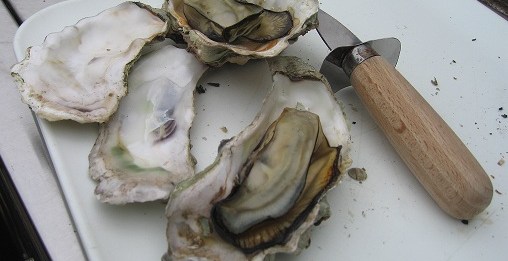
By now I had noticed all of the oysters everywhere. The tidal range is about 5 feet at Hilton Head, so at low tide you can see a lot of marshes and mud flats, and they were covered with oysters. Well, I know better than to eat oysters from around a marina. Oysters filter the water to feed, and boats use an anti-fouling bottom paint that leaches into the water, the marina sells fuel, and any other waste that may be discharged into the water, intentionally or not, will be filtered by the oysters and toxic levels of very bad stuff can build up in them. Waters near golf courses and farms are other areas from where I would never take oysters. Those places tend to use a lot of fertilizer and pesticides which can run off into the waters when it rains heavily. I have been lucky and have never eaten a “bad” oyster, and I hope I never do.
When the weekend came I took my boat out to find an area that looked to have clean water and a lot of oysters, and soon I found a spot. As the tide dropped, there were oysters for the “picking” everywhere. I normally prefer my oysters steamed as opposed to raw, but not that day. The first couple of dozen I collected I popped open, rinsed in the creek and slid into my mouth, and they were incredible. I don’t know how many oysters are in a peck or a bushel, but I had a cooler-full.
I took my boat back to my slip at the marina, then I steamed oysters until I could not eat another one. What I did not eat I would be able to keep alive by keeping the water “fresh”, so I would eat oysters for a couple of more days at least. And I did. I ate so many oysters that I swore I would never eat another oyster again. But just as I did with all 10 pounds of potatoes, I ate all of those oysters. I had to. I was out of all other food – almost. They mystery food was all gone, as were all of the potatoes. All I had left were flour and some home made jelly.
I have never claimed to be a great cook, but I had to do something after coming home from work. Instead of just getting a spoon and eating jelly, I got some flour and added a bit of water. Just enough so that I could shape and work the dough. I tried to flatten it out like a tortilla, then I fried it in oil. I have had people tell me that I did make flour tortillas, others have called it pan-bread, but they did not taste it. It was fried flour, plain and simple, and it was not good. Thank God, actually, thank-my-big-sister for the homemade preserves. At least the fried flour gave me something “edible” to spread the blackberry jam and apple butter on.
Now I was into the week that payday came. Just got to make it till Friday. Then I can go out for a steak if I want to. Mmm, and a salad bar!! All the sweat tea I can drink! But not until Friday.
Being off on a boat, living day to day, week to week, you tend to lose track of time. If it weren’t for the Monday thru Friday job that I had at the time I would have no clue as to what day of the week it was. My calendar went more by the sun and the weather. When the days got long and the weather was hot, it was time to head north. When it started to get cold, follow the birds south. With that loose schedule, and add in a lack of television or newspapers, I was very surprised when I was told that I did not have to work on Thursday – it was Thanksgiving. I was informed of the employee party on Wednesday night, the day before Thanksgiving. And it was to be catered!
That was a big surprise. I knew that it was a corporation that I worked for, that is why I was not in a position to get an advance from my boss. But I did not know that so many people around the marina, the boat brokerage, real estate sales and maintenance all worked for the same boss as I did.
What that meant for me was a big party, and a lot of food. Boy, did I eat. And eat and eat and eat! My boss in the boatyard knew of my limited menu over the last 2 ½ weeks, and he must have spread the word. I had a few people come up and ask if it was true that I had been eating nothing but oysters and potatoes for two weeks. I said “no, I had some fried flour too – with homemade jelly.” After a few drinks among the partygoers it had become a much talked about subject. That was fine, I was fat and happy, and for a bonus, I got first pick of the leftovers to take home. I took some turkey and a whole pie.
As I mentioned at the beginning, that was one of my first sailboat cruises. I like to think I have learned a lot since then, things like:
I try not to get so broke before I stop;
Carry a lot of rice at all times;
Roll your own tobacco;
A big jar of peanut butter goes a long way;
And always, always use a magic marker to write the contents of canned food on the top of the can.

  The End

Gunkholing

Years ago I was up in the Chesapeake Bay, somewhere in Maryland. I don’t know what the year was, but I was in my twenties.
I had spent the summer cruising and exploring the western shore of the Chesapeake Bay, something known as “Gunkholing” up in those parts. I had no rhyme or reason for the places that I chose to go to, Continue reading

By Sullivan Family

Contentment

                                         MASTER AND COMMANDER


“Red in the morning, sailors take warning.” Every sailor remembers those words from his childhood, but what does “light rain in the morning” forewarn? That is what I was destined to find out for myself as a wet, gray dawn broke the Maryland sky one May morning.
I had my 27 foot sailboat “Soulshine” ready for a 105 mile trip up the Potomac River to our nation’s capitol.
This trip was to be a first for me in that I had never before attempted to venture so far inland up a river.
I was starting out from Point Lookout Marina in  Southern Maryland. I happened upon this out-of-the-way marina — complete with a boatyard, first-class restaurant, picnic area, and beautiful gardens — the same way in which I had ended up at so many other places; by sheer chance.
I was in my mid-twenties and I had been sailing well beyond my means. I was broke and my galley was low on food, so I anchored near to the marina and rowed my dinghy to shore to look for work.
My timing was perfect. It was early May and the busy Chesapeake Bay sailing season was soon to start, so there was a lot of work to be done at the marina.
The owner of the marina was a man in his 70′s named John. He seemed to take a shine to me when I explained my situation — that I was basically just cruising around on my sailboat, stopping for work when I needed money. He offered me a job for a couple of weeks doing basic handy-man work, helping to get the marina ready for the busy season. They pay was not going to be that great, but then, the work was not going to be that hard either. And, bedsides, I would be getting paid in cash and be allowed to tie up to the dock for free. It seemed perfect.
Work started off as good as work can. I was given the simple task of using stencils to paint numbers on the individual slips on the docks. It was going to take a while to finish it — there were a couple of hundred slips, and I had to paint the numbers on each slip twice — once so you could see it as you walked along the dock, and the other so that you could see it from a boat approaching on the water.
I was only a couple of hours into my first day of work when John came to me and told me that he needed me to ride to town with him to get some things. It didn’t seem to me that he really needed my help, but rather that he just wanted some company. John was an old sailboater himself, and like every other sailboater that I’ve ever met, he loved to spin a good yarn. Since John was the boss, he could hijack me from my duties whenever he wanted to, and in fact, it was to become a regular part of my employment.
Over the course of a couple of weeks working at the marina, my labor became a hot commodity. Besides my various assignments from the owner, the boatyard manager was always wanting me to work in the boatyard painting boat bottoms, the owner’s wife wanted me to help with her many flower gardens, and the operator of the marina restaurant wanted me to wash dishes at night. My temporary employment seemed to be in danger of becoming a real job, so I felt that it was time to assert my independence by announcing my intention of sailing to D.C.
I gave four or five days notice of my departure, but since I would be sailing right by the marina on my way back downriver (and most likely be broke as I did so), I agreed to return and finish up the list of assignments that John had for me which I never got around to doing. Now the work was behind me; my pantry was stocked, my cooler was full, and there was cash in my wallet. I was ready to go.
On the morning of my scheduled departure, the temperature was mild and the wind was fair. A slow, steady rain was the only drawback, but I was not going to let a little bit of rain delay me.
Every sailing trip, especially one into unfamiliar waters, comes with varying levels of excitement, anticipation, and trepidation. As I untied my docklines and made my way out to the Potomac River, my mind brought up images that I associated with river sailing: strong currents, floating debris, heavy boat traffic, and narrow waters. At least narrow waters wouldn’t be a problem as I started out — the Potomac River is about seven miles wide at its mouth.
Despite the rain, it was a good day for sailing upriver. The outboard motor on my boat was not very reliable. In fact, it was a piece of junk. But so what! My boat came with sails for a reason, and with the wind direction the way it was that day, I would be sailing downwind.
I got my sails set, turned on the auto-pilot, and then got out of the rain as much as possible. The auto-pilot is a wonderful device — I named mine Gilligan– but it can’t do everything. The way the auto-pilot works is that once I get my boat on the desired course, I engage the auto-pilot, and it moves the tiller as needed to keep the boat headed on the set course. For the auto-pilot to be able to do this, the sails must be set properly and trimmed as the wind shifts. So although the piloting of the boat is hands-free with the auto-pilot engaged, I couldn’t go down below to the cabin to stay completely dry. Besides, I had to keep a lookout for other vessels and adjust my course to follow the channel.
I had planned on two days to get to D.C. I would sail all day the first day and look for a safe place to anchor before it got dark. The following day, I would get up early and finish my trip.
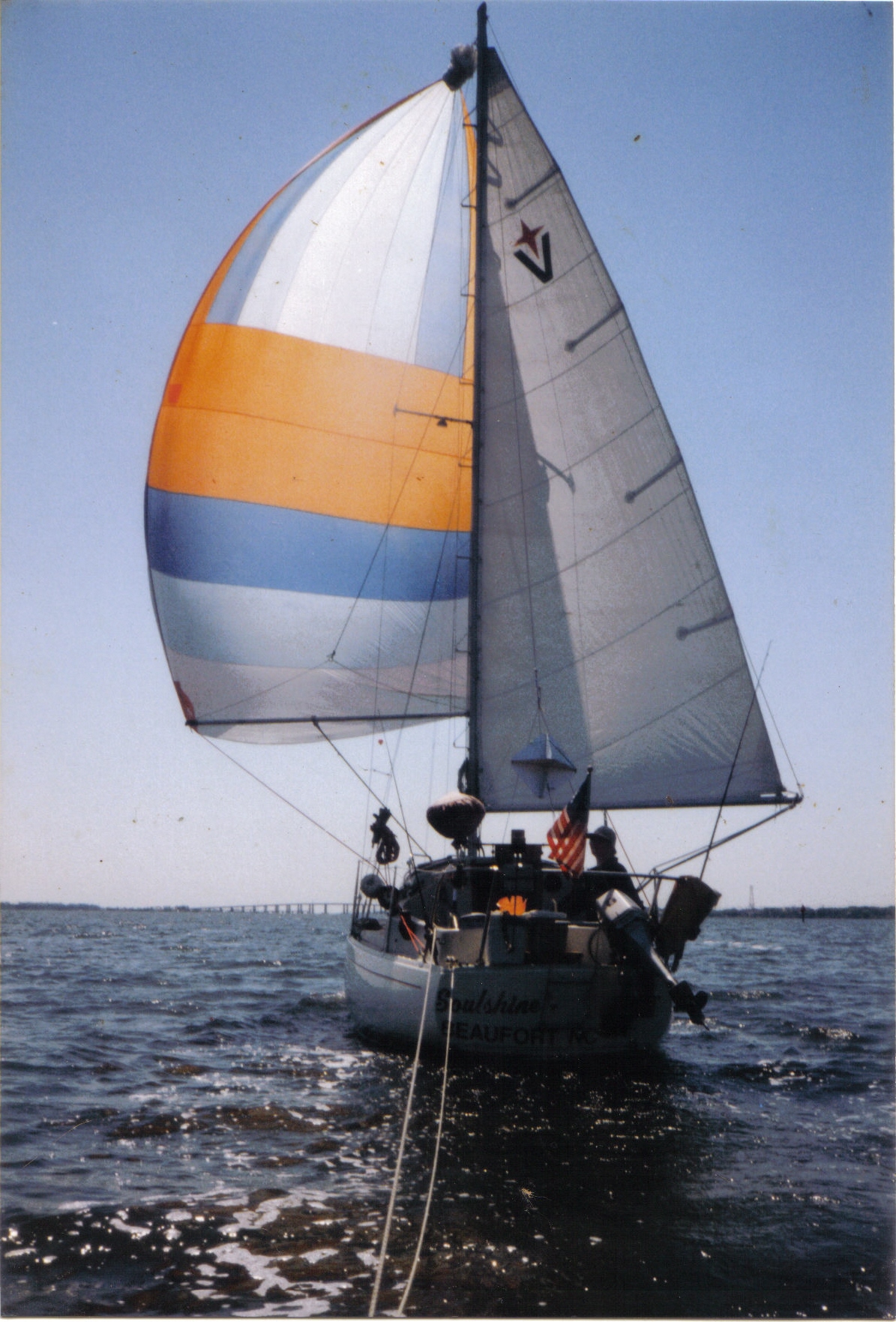
I wanted to make as many miles as possible the first day, so I decided to fly my spinnaker. Flying a spinnaker (a very large, multi-colored sail, also known as a “chute”) is not an easy task, especially when sailing single-handed. In fact, one of my sailing books says that it takes a crew of four. My boat though, was designed to make sailing single-handed easier, and I had some tricks, including my auto-pilot, that made it possible to fly my chute without any crew. Still, I only ever attempt to use it when the wind is light and constant in direction, and when I will not be changing course for a while.
That was the case on this day, so I decided that it was worth the fifteen (or so) minutes that it took to set the chute, and also the extra attention that was required to tend to it.
When all was said and done, the spinnaker was set and flying beautifully. I was kicking back in the cockpit admiring my boat, myself, and my life in general. I was also making great boat speed.'Soulshine' wuth the spinnaker flying
My day was going great. I only had to make minor course changes to follow the channel upriver, and Gilligan was doing a fine job at the helm. The hours and miles were flying by.
Later in the day, while scanning the horizon for markers and boats, etc., I noticed that the mast of a sailboat well behind me, at the limit of my vision. In days gone by, a vessel such a distance was referred to as being “hull down.” As it neared, and the hull of the boat became visible above the horizon, it was said to be “hull up.”
Due to the distance of the boat behind me, and the weather conditions, all I could make of the other boat was that it was a sailboat with no sails raised. I couldn’t guess at the size of the boat, nor its heading, and I really didn’t expect to see much
more of her. If she was heading upriver, like me, then she would have a hard time catching up to me. My spinnaker was still set, and it was pulling me downwind at close to my maximum hull speed.
So imagine my surprise when the mast behind me kept getting taller and taller, meaning that the boat behind me kept getting taller and taller, meaning that the boat behind me was getting closer and closer. I could now make out that it was a two-masted boat, but she remained hull down. As she ate up the distance between us, I began to realize that she was a very large boat. Shoot, she was a ship!
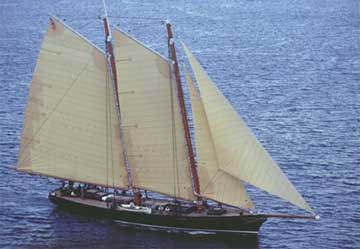
When the ship caught up to me, the Potomac was a couple of miles wide, and she never got closer than a couple of hundred yards to me. Because it was still raining, I couldn’t get a very good look at her as she passed me by. Still, she was close enough that a few things stood out; She was a schooner – a twin masted sailboat in which the foremast is shorter than the aft – or main mast. She was also the largest sailboat that I have ever seen under weigh. She had to have been over 100 feet long!
As the schooner had been catching up to me, I knew that she was moving fast, but now that she was overtaking me, I got to see just how fast. She was going faster than I had ever seen a sailboat go before.
I was sitting out in the rain, trying to get a better look at her though my binoculars, when I heard a call on the V.H.F marine radio.
It was a female voice, and it said, “This is the schooner ‘America’ calling the sloop near (whatever channel marker I was at) on the Potomac River.”
I answered, “Schooner ‘America’, this is ‘Soulshine’… go ahead Capitan.”
She asked me to switch to a working channel, so I did so. (On marine radios, Channel 16 is used for hailing and emergencies only. When you contact your party, you agree on which working channel to switch to. Once on that working channel, you are free to talk all you want to.)
She called me back and said that she just wanted to compliment me on my boat. Then, in a teasing manner, she told me what a pretty color my big sail was — but didn’t my Momma ever teach me to come in out of the rain?
I responded that it was a lot of work to fly that big, pretty colored sail, but I wasn’t going to let a little rain stop me.
Then I said mockingly, “I’ve got to tell you — that’s a beautiful motorboat that you’ve got.”
That got her good!
She got defensive and told me that they had a reservation at midnight for an opening of the I-95 drawbridge near D.C., and that they needed to keep their speed up to be sure to make it on time.
I knew what she meant about the drawbridge. To get them to stop traffic on I-95 and open the drawbridge, you have to make a reservation at least 24 hours in advance, and even then, it will only open between midnight and 6AM.
I didn’t have that concern, though. My mast was not tall enough to need the bridge to open for me to pass under it.
I was told that they would be docking the ‘America’ at the city marina in Alexandria, Va., and that I was invited to stop by for a cocktail.
I thanked her, and told her that I might take her up on her offer. That was about it for our conversation, and the ‘America’ quickly left me behind.
The rest of the day was uneventful. At the end of the day I dropped anchor right off the FBI training center in Quantico, Va., and had a peaceful night.
I awoke the next morning to a beautiful sunny day, and I continued my cruise upriver. I sailed by Mt. Vernon, and as I did so, I blasted my horn (for my lack of a cannon) in a traditional salute to the father of our country. That was kind of cool.
It was early in the afternoon when I made it to Alexandria and saw the ‘America’. When I got to the city docks where she was moored, I saw that there were plenty of empty slips, so I decided to stop by for that cocktail.
I didn’t call the dockmaster for a slip. I wasn’t planning on staying for long, so I didn’t want to have to pay overnight dock fees. If the dockmaster came to me after I tied up, I would deal with it then. It was my time-tested mantra of “It’s sometimes easier to ask forgiveness than it is to ask for permission.”
I got ‘Soulshine’ tied up and walked over to the ‘America’. I introduced myself as the captain of ‘Soulshine’, and I was invited aboard. Once onboard, I met the captain, the lady with whom I had spoken to on the VHF, and some of the crew. I was given a tour and learned about the ship.
She was 139 feet long, and a replica of the 19th century schooner that won the first race that, from that point on, would forever be called “The Americas Cup.”
She was brand-new – built in Albany, NY and just launched. Although she was a replica of a ship originally built in the 1800′s, she was totally modern. She had a fiberglass hull and down below she was amazing. The galley was huge, and came complete with a water-maker, refrigeration, freezers, etc. The staterooms were incredibly nice, and she even had a washer and dryer.
After the tour, we all sat around in her beautiful, round cockpit and had a few drinks. That led to us telling each other extravagant tales of our own sailing adventures.
Quite a few drinks later, I made my way back to my boat. After experiencing the grandeur of the ‘America’, she seemed so small. As I sat there, reflecting back on my conversation with my new friends, one thing really stood out.
Here were these folks on this huge, brand-new, four million dollar vessel. I was told that everyone onboard the ‘America’ had their eyes on my little boat as they passed me by. While they were huddled down below, keeping out of the rain, hurrying to get where they were going, they spotted my spinnaker well ahead of them. When they caught up to me, they saw me sitting out in the rain, seemingly enjoying the hell out of myself, and that’s what prompted them to call me on the radio.
It reminded me of a story that I once heard:
A man and his young son went out on a fishing trip. They were on a small, leaky jon-boat with an old outboard motor, and they were fishingith cheap rods and reels.
As they were fishing, a big, million dollar sportsfishing boat went by. She was a beautiful boat, equipped with thousands of dollars worth or fishing gear. The man in the jon-boat pointed to the big boat and said to his son, “Now that’s fishing.”
At the same moment, in that big sportsfishing boat, was an older man and his grown son. As they slowed down so as to not to rock the little jon-boat too badly, the older man looked down at the tiny boat with the two people onboard, and he was reminded of similar days that he had spent with his own son so many years before. He pointed down to the little boat and said to his son, “Now that’s fishing.”
I had been looking at the ‘America’,  jealous of all her amenities, her spaciousness, and of her ability to sail anywhere in the world. Yet at the same time, those onboard the ‘America’ were looking at me and ‘Soulshine’, envying her simplicity and the freedom that I had that only comes when one is master and commander of his own vessel.
The next morning, I made it the final few miles to D.C. I was high on life as I dropped my anchor within sight of the Washington Monument. I had already had a great trip to D.C., and I hadn’t even stepped ashore yet.
For me, that’s the beauty of sailing; the journey can be just as rewarding as is the destination.

THE END

By Sullivan Family
Saga - Sandy Island for wp

Saga, the boat

Saga is a 1962 Allied Seawind cutter-rigged ketch. She was designed and built to be an ocean-capable world cruiser. A sistership of mine, also a 1962 Allied Seawind, was the first fiberglass boat to sail around the world. Continue reading

By Sullivan Family